
 August 13, 2012
A Review of 5 Outstanding Audio Books
When fellow tribe member and blogger friend, Ellie Heller, asked me to write a post featuring my five favorite audio books, it took me less time to jot down those titles than it did for WordPress to process my user name & password so I could keypunch my reply: “I’m in.”

Oh! Oh! And this one, and that one…and that, one, too!
That’s how near and dear my little nuggets of “Once Upon a Time’s” are to me, and it was tough to narrow it down to just five. I listen to audio books at least four afternoons a week at my job as a personal chef. While my hands slice and dice, my mind leaves the building as sneakily as Elvis ever did, wandering along spoken footpaths or hurtling down multi-tiered, L.A. style freeways…And sometimes footpaths that merge with such freeways in the same breath! Literary–if not literal journeys–I embark on effortlessly, letting the narrator take the lead on vistas carved by author imagination.

Synapses TrailHead
In the case of audio books, the voice is everything. The same book enjoyed in hardcover can be an excruciating assault to author, listener, and the work itself as easily as it can be a mesmerizing escape into the delightful place of: “Tell me a story”. Conversely, a book that’s only so-so in print can become sassy and engaging when read aloud by a favorite narrator. It’s no small skill to modulate your voice from character to character, and convey action and emotions with only inflection, timing and words—musicians appreciate this nuance, I’m sure–but the best of them do it seamlessly. Like a smooth ride in a fine-tuned car, the method of conveyance falls away and the listener simply experiences what becomes the listener’s story as it unfolds. And the first narrated tale I’d like to note is…ta-ta-ta-ta-ta-ta-ta-ta —(ta—koff, koff—ta!)
The Grapes of Wrath. Author: John Steinbeck; narrator: Dylan Baker. Dylan Baker does a fine job narrating all the characters in John Steinbeck’s Pulitzer Prize winning novel. It doesn’t hurt that Baker’s sometimes reedy voice is reminiscent of Henry Fonda’s vocalizations, the actor that starred in the movie version of the epic, but in the case of this first book, I simply must focus on the material itself. It transcends any MOD, be it page, audio, film or adaptation, and if you’re a Steinbeck fan, I know you’ll agree.
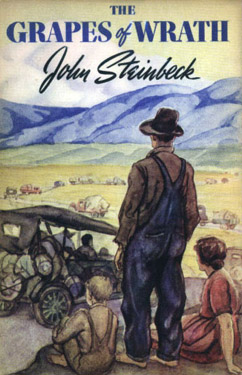
Image: Viking, New York
From its weighty title fraught with patriotic and biblical connotation, to its incredible end scene and dialogue (I’ll leave that out, for obvious reasons) the politically charged novel is the result of Steinbeck embedding himself in the very—and very real—situation the novel addressed: the forced eviction of sharecroppers from Oklahoman farms by landowners and banks during the thirties, when the infamous “Dust Bowl” conditions ruined the wheat crops the tenants’ relied on to pay mortgages. The sharecroppers fled by the thousands to a non-existent Utopia in California; the symbolic pot at the rainbow’s end for the migrant worker: the money earned from harvesting the grape.

How do you like them grapes? Sour or wrathful?
I could go on talking about it forever, too, for a full side of an audio book at least, or a full post of its own, so I’ll sum up by opining why it’s #1 on my list. Steinbeck’s brilliant prose intersperses the real-time journey and experiences of the Joads—the fictionalized family depicted in his epic—with generalized to specific description of the state of affairs in the country at the time he wrote the work: the Great Depression. With master intuition, he knows just where to break from third-person narration to thorough exposition interwoven with vividly, painted backdrops of the Dust Bowl and the Golden State.
That’s why it’s #1 on my list. Because it resonates. Because portions of that book affect my worldview every day—from its literary form, to its unapologetic content. The writer in me knows there’s always a better way to say it—a Steinbeck way to say it—while the citizen in me flat-out likes what the man said. Government isn’t fair, and laws are always skewed in favor of the deeply pocketed, specially-interested few instead of the hard-working populace that keeps those pockets lined. Even as I type, our nation is mired in a years-long recession that parallels or exceeds the time of economic hardship for the majority of which Steinbeck wrote. How closely current day affairs in America echo his portrait of governmental collusion with Special Interests is another question entirely.
The answer to which wouldn’t fill in the blank for my second audio book, anyway. A Clockwork Orange would, though. Written by Anthony Burgess, & narrated by: Tom Hollander, the reasons this dystopian novella is a favorite is a direct result of the author’s unremarkable choice to write in the first-person “I” voice–my favorite point of view to assume as a reader–and his hugely remarkable choice to write that voice in an entirely fictionalized, secret language. An argot that blows the roof off Twain’s egregious yet lauded abuse of the language, and won Burgess literary acclaim, too.
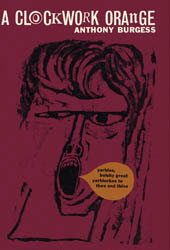
Wikimedia Commons
Narrator Tom Hollander serves up the delightful patter in the requisite British accent—and then some. His delivery of language that substitutes the term droog for pal, gulliver for head, and itty for “to go” is so brazenly fluent I’m convinced there’s a brand of Cockney slang I’ve missed hearing about. Better still, the context in which these words appear is so well written I know exactly what he’s saying simply by point of reference! That the ratio of real words to pretend terms is roughly 2:1 only further indicates Burgess’s mad writing skills…And the storyline that follows the trials and tribulations of a violently criminal youth being brainwashed by the police? Well, that’s almost an added bonus, in this Humble Narrator’s opinion.
My third pick is Life of Pi. Author: Yonn Martel; narrator: Jeff Woodman. I’ve clearly gone long on this post, so in the interest of keeping whatever audience remains, I’ll try to brief. (ROFLMAO) Ahem.

The book cover looks all kinds of restricted, so here is a nice picture of a Tiger instead. Just think…if you pick up Life of Pi, you too could be skimming the waves in a tiny lil lifeboat with Tigger, too! What fun…>^^<
This is the story of a young man adrift on the ocean in a lifeboat with nothing but a tiger, an orangutan, a zebra and a hyena for company. If I have to explain why this story has EVERYTHING a story needs—from its bang-up cast of characters to allegorical subtext galore–well, you probably wouldn’t like it anyway. Suffice to say, I’ve read and re-read this book, and heard and re-heard it, too. That’s how it is with the good stuff—story, narration, and many other things in life, alike.
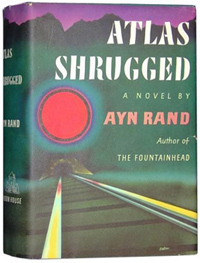
My fourth top pop is Atlas Shrugged. Author: Ayn Rand; narrator: Edward Hermann. In the style of Steinbeck’s Grapes of Wrath (or East of Eden, even) this epic details the story of civilians butting heads with the government, but from a grander perspective. Railroad giant Dagny Taggart and steel magnate Hank Rearden face coercion by the “National Legislature” to run their businesses the way the government tells them to—for the betterment of that body, and to their decline–but Hank Rearden won’t be coerced. Nor will the other movers and shakers of industry in this tale. Atlas Shrugged imagines what would happen if society’s most productive citizens refused to be exploited by increasing taxation and government regulations and “went on strike”. An amazingly simple concept that brings to mind the mythological Atlas refusing to support the world any longer, and one well worth exploring for real.
Speaking of exploring. You still with me? You are? Well, come on, then, what say we wrap this up with a heart-warmer that features as many cuddly puppies as it takes.

Uh, boys, don’t look now, but there might be a huge kitty directly above you in this post…no cause for alarm or anything, just…don’t look up!
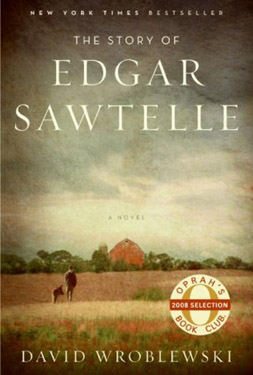
The Story of Edgar Sawtelle is my fifth favorite. Author: David Wroblewski; narrator: Richard Poe. This story of a deaf/mute first raised on, and then running a dog whelping farm plays every note on the harp of human emotion, and narrator Richard Poe is just the right harpist to strum this poignant and empowering tale. He’s the best choice on which to end this admittedly narrator-lean post, too, for that matter, for all that I said they were key. Because he sets the bar.
Orson Welles, high. Morgan Freeman, pleasing. As James Earl Jones as he wants to be. His naturally resonant baritone is able to assume the higher pitch of female characters perfectly, and without a hint of the absurd, and his delivery commands my attention. I never miss anything when Poe reads to me, I tell you, never have to hit playback, although I do occasionally just to appreciate a good passage again. His voice is every beloved teacher at story-time I ever had mixed up into one adult-sized treat for my ears.
I mean, come on. His name is Poe.
There it there, then. My pin board at the Pin Place has over 100 additional, favorite titles, too, from The Tao of Pooh Through the Looking Glass with Alice, the Annotated Version, in case you’re interested in more awesome books. (click: here to go to that board) Thanks again to Ellie Heller, author of: Ginny’s Capture and blogger at: Ellie Writes 2 for the suggestion. This “exchange titles” post sure brought back some fond memories–all of them borrowed from the minds of others. Or should I say: the minds of authors?
Click & read poem: Outside the Box for a nominal but direct play on argot mentioned in Clockwork Orange paragraph.


 Charron's Chatter

Some great choices! Narrator is key, key, key to all of these. Thanks for the list, more great stuff to listen to. 🙂
Thanks for asking, Ellie. I’ll touch base on FB as to how I pass the “5 Books” baton “officially”.
Oh, you should ask 2-3 friends if they want to do it and put links to their blogs at the bottom of your post. I skipped the first step, but it turned out great anyway!!