
 August 15, 2012
4 Favorite Phrases from 4 Awesome authors.
Warning! This post has received a TripleM rating by the Idiom Council of America. (many mixed metaphors) In compliance with international simile laws, and consumer reading caveats particular to the U.S., I’m obliged to inform you of the following: You’re reading on thin ice, here, and if your Spidey sense starts seeing double at any time during this post, you better hang ten, and write it off between the lines as a straight-up, rinse-repeat.

I never met a 4 I didn’t like, nyuk-nyuk…
Glad that’s out of the way. Now we can get down to the brass chase of it. The raison de blog, and the raison is quite simply this: my recent post about favorite audio books brought to mind some other favorite, book-borne goodies, and I bet you can’t guess what those are. Hint: it isn’t forgotten but stylish bookmarks, library fines under the double-digits, or made-from-the-book movies, either.
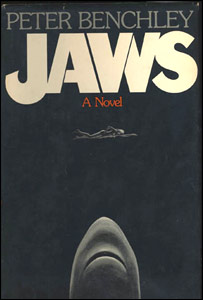
Infinite words. Sounds like: dunh-dunh-dunh-dunh-dunh-…source: http://news.bbc.co.uk/
It’s quotes, of course! I speak of quotes. Not in quotes, or air quotes, but: “You’re going to need a bigger quote.” quotes, and while I invoke comedic license with that line of dialogue from Benchley’s Jaws, it’s the million dollar answer all write.

Where’s that phrase again?
Almost an extra in a well-written book, a thought-provoking phrase gives me the frickin’ shivers. No exaggeration. The shivers. Physically and spiritually both, the well-turned and provocative axiom amid pithy prose provides an instant cause to reread—to remember & to annotate, to deconstruct & to replay, ’till death we do part. The universal truths with which such gems resonate acts as glue as much as a wake-up call, binding the phrases to me as surely as pages to seam in an irrefutable union of concept to self.

Heyy!! Is this a “paste” diamond?!
So let’s celebrate some anniversaries. I’ll get busy decorating this post with a few, finely cut sparklers, and you fetch a sweater as a proactive measure for the chills that will surely follow. Oh…and if you have to burp because of ingesting so much soul food as you read further? You go right ahead. It’s a compliment in Europe, and I don’t mind for a minute if you want to quote me on that. Just don’t do it in “Burp-ese”.
As gleaned from: Of Human Bondage, author: Somerset Maugham.
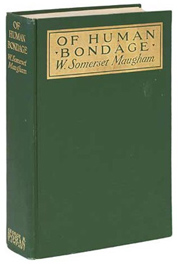
Source: http://www.betweenthecovers.com/
Context: An orphan boy in the care of a childless aunt—a lack that causes her great distress—tells her he hates her, and causes her to cry. After a period of burgeoning realization of causality on the boy’s part, he symbolically kisses her cheek for the first time without direction to do so, triggering a cathartic displacement of the woman’s larger grief into this “crying opportunity”. To paraphrase: she cries her heart out happily, all strangeness between them gone. And then the bling:
“She loved him now with a new love, because he had made her suffer.”
My Thoughts: First off, who among us hasn’t let a sniffle-worthy slight mushroom into a tissue-soaked bawl? Pretty much no one, that’s who, so a straight up bell-clanger of universal truth in the tension-building context, alone. Secondly, the inflictor of pain is loved more by the wounded party, and by more I mean not only is the hurt tolerated, but the one wounded subsequently tries to “fix” that which the hurting party perceives as irksome.

Why is that? Is it because the effort to hurt shows an effort at all? Or does it go back to the idea: in every relationship there is one who loves, and one who is loved. Of course, that would denote a collective sense of inadequacy instilled in roughly half the world population, so maybe it’s more case-specific. Is it because the hurt is perceived as deserved?
You see where I’m going with this. An infallible statement is just 20 questions in disguise, and while I don’t know whether it’s animal, mineral or vegetable, I do know I had to stop and consider a lot of things when I read that line. Truth rung like carillon, and my goose-bumped self knew I was chowing down on some serious soul food. Like this morsel of goodness here, albeit from a completely different kitchen.
As gleaned from: “The Pearl”, author: John Steinbeck
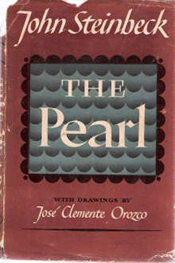
Source: The Viking Press
Context: A desperately poor fisherman finds a magnificent pearl of unprecedented size and value.It seems as if all his troubles are over, but it soon proves he’s only exchanged one set of problems for another—and these have far greater consequences. Obliged to store the gem in his hut until he can make his way to a pearl buyer, his life situation deteriorates as his suspicions toward his formerly friendly neighbors grow. He’s in the process of burying and reburying the pearl in different areas of the dirt floor in his pitch-dark hut, when this line comes up:
“Then from the corner of the house came a sound so soft it might have been simply a thought…”
My Thoughts: Though the allegory wherein this gem falls is age-old, Steinbeck finesses its entirety in this inimitable terminology—The Pearl, a jewel, through and through. I remember abandoning the Stairmaster mid-step to jot this down, and it definitely redirected my attention from the story—and the Stair’ing–for a good ten minutes as I contemplated its wonderful succintness. It was so food-for-thought filling it even had a finish, so when the Stairmaster’s program completion tone buzzed shortly thereafter, I swear it sounded like the ring of truth to me, too.
As gleaned from: “East of Eden, author: John Steinbeck
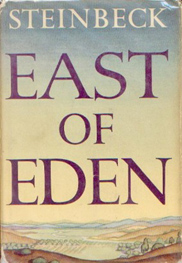
Yes, I’m counting Steinbeck as 2 authors–because he’s 2X as good as most, and because it made for a far better blog title..:) Source: antiqbook.nl/boox/zaa/141.shtml
Context: The hair-crawler in East of Eden comes about midway through an epic spanning generations, during an expository break from narrating the tale of two, warring brothers. It’s a direct reference to the story of Cain & Abel, and an oblique allusion to the book’s, dysfunctional siblings. Steinbeck weaves the biblical allegory into his famous descriptions of the Salinas Valley (Cannery Row & Grapes also feature such epic topographical detail) and explanation of the scriptural origin of the book’s title. And then, as if that’s not sparkly enough, he unearths this diamond:
“If a story is not about the hearer, he will not listen. And here I make a rule—a great and interesting story is about everyone or it will not last. The strange and foreign is not interesting—only the deeply personal and familiar.”
My Thoughts: I could barely hear them the bells of truth rang so loudly. The veracity with which this resounded was deafening. I read and reread it, I played and replayed it, I wrote it down in journals, and even created a quotation card out of it to pin at Pinterest. Giganter goose bumps aside, I’ve mulled this over from many angles, and no matter what angle from which I deconstruct, its perfect truth is da Vinci beautiful. Socrates profound. The stories I like best are those familiar enough for me to assume the lead role, yet at the same time keep me guessing on every single page. The premise universal—the plot, fresh.
As gleaned from: “Elegance of the Hedgehog, author: Muriel Barbery
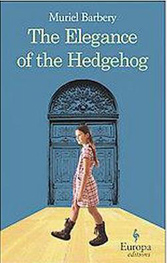
Source: SB Black Gold
Context: The internal dialogue of a highly precocious, 12 year-old who’s just declared her plans to kill herself the following Friday. She’s speculating on the ease of duping her elders; family and teachers alike, and Welltschmerz, in general–her remarkably heady thoughts coached in where’s-the-dictionary prose. I must have “autodidacted” 50 new words reading this book, and while the vocabulary lessons were taxing—involving as much repetition and contemplation as the “gem” itself–the effort I put forth was less diminishing than this shiver-inducing thought:
“It really takes an effort to appear stupider than you are…”
My Thoughts: It does. A lot of stupid effort that ultimately boomerangs. And so, chickens, with this gratuitous, piece of sporting equipment thrown into this metaphorical, mix o’ metaphors and quotes, I’m off to contemplate why my ability to articulate decreased in direct proportion to the documentation of these award-winning sentences.
“Uh, duh…until next time!”
Context: as written by Karen, at the end of long, old post.



 Charron's Chatter
Comments are closed.